Why strength training develops more than muscle

Something fires before the words form.

You feel tension, a collective pressure. You sense a shift but can't find the words. A slight discomfort, an abnormal state, with no explanation. You check your surroundings. The room hasn't changed. Your body has.

Enter

The Ratio You Were Never Told About

You've felt this before. The moment between normal and sensing something is different. Not wrong. Not right. Different. A signal arriving before the cognitive interpretation.

You've been taught to override it. Reach for the phone, check the time, label the pressure as anxiety and move on. The signal dissolves into distraction, gets absorbed by life noise. Eventually, your mind stops receiving what you've trained yourself to ignore.

But your body doesn't stop signaling.

Right now, beneath every conscious thought, your body runs a signaling operation of staggering complexity. Your fascia carries seven interoceptive nerve endings for every one proprioceptive nerve ending. Seven channels sensing conditions for  how you feel for every one tracking metrics for  where you are.

The 7:1 Ratio
7 interoceptive · "How do I feel?"
1
Your tissue contains 7 interoceptive nerve endings for every 1 proprioceptive ending. Seven channels sensing state. One tracking position. You are biologically wired for feeling over locating. Traditional training inverts this.

Your cognitive default has been the one. The seven have been running without you.

You are wired 7-to-1 for state over position. And nobody told you.

The Frontier Nobody Named

A Stanford neuroscientist spent two decades building machines that navigate external space — robots that see rooms, estimate distance, interact with physical environments. She called it spatial intelligence and named it the next frontier beyond language. She's right. But she's looking in only one direction.

While the world races to build machines that model external 3D space, nobody is systematically training humans to navigate internal biological space — the neural territory where your seven interoceptive channels sense state, process stress, regulate adaptation, and compose response. Internal spatial intelligence is the capacity to consciously access and navigate your own somatic signaling architecture. Not as metaphor. As trainable skill. Developed through load, developed under load, refined through repeated exposure, and expressed as adaptive actions that extend into every domain where pressure arrives.

BASEWAVES trains the other direction. Most stress responses are reactive — the system fires after the threshold is crossed. This builds the sensing capacity before the threshold arrives, under controlled conditions, so it’s available when they aren’t.

The ratio was always there. The frontier was always internal. Nobody named it because the very capacity required to see it — internal spatial intelligence — was the thing that had gone untrained.

Competent Material

Your body is not a machine that needs programming. It is an intelligent system that needs communication.

Every cell participates in a collective intelligence that knows how to build, repair, adapt, and respond — without your conscious instruction. Your immune system solves problems you can't articulate. Your wounds heal through coordination you never orchestrate. Your bones remodel along lines of force without being told which lines matter.

You are made of competent material.
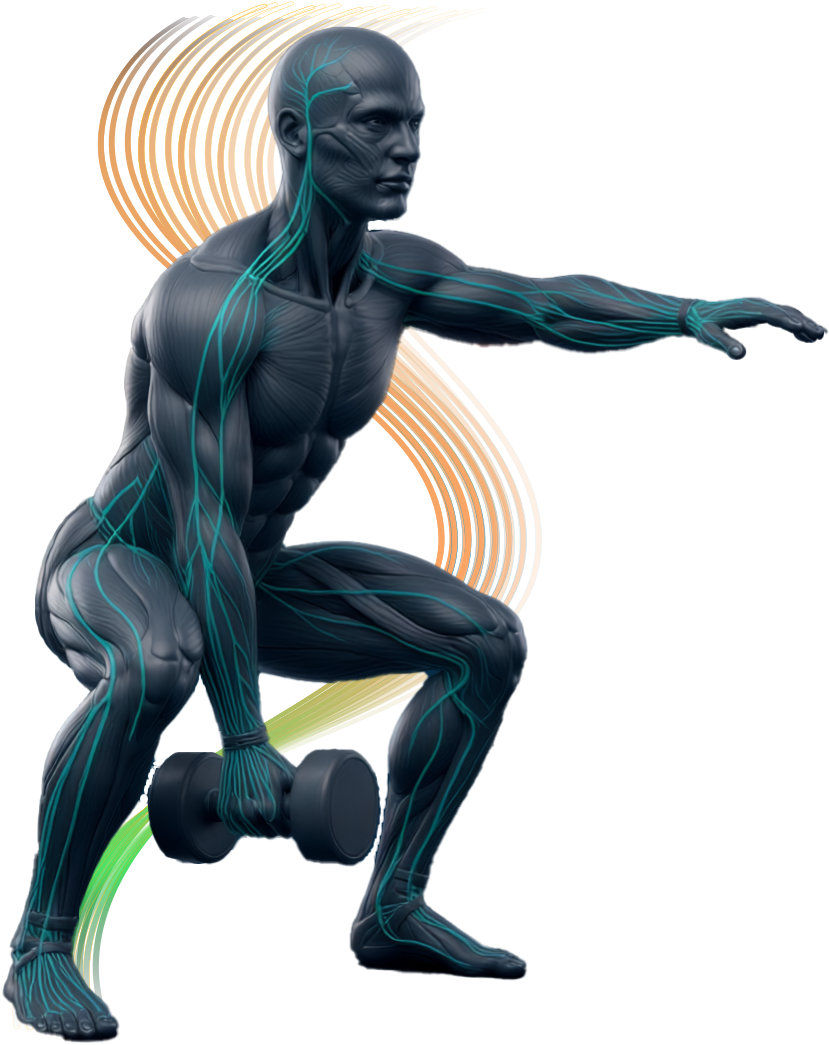
Neural pathway figure — signal architecture under load

When you place your hands on a dumbbell and lower into a squat, you are not telling your muscles what to do. You are communicating a constraint — a goal state — to a cellular collective that has been solving movement problems since before you had language. The dumbbell doesn't build you. It speaks to something in you that already knows how to respond.

You don't build capacity. You clear the interference that prevented capacity from expressing. The capacity was already there. The signal was blocked.

When the interference clears, physical adaptation follows. Load tolerance increases. Compensation patterns resolve. Force production becomes coherent across the whole kinetic chain rather than leaking through structures that weren't designed to bear it. You get stronger — not because you chased strength as a metric, but because your system became organized enough to express it.

This requires metabolic readiness. The body adapts under load only when metabolism adapts — adequate fuel, adequate sleep, manageable stress. Train against your metabolic rhythm and you produce breakdown without adaptation. Train with it and every session compounds. The signal cascade runs: metabolic state determines what your brain can process, which determines what your body can organize, which determines whether load produces growth or depletion.

The Gap Nobody Built For

Somewhere between the stopwatch and the spreadsheet, training became override practice. Push through. Ignore signals. Chase metrics. The body sends information constantly — fatigue, compensation, misalignment, readiness, capacity, rhythm — and the cultural response to all of it became identical: work harder.

The cost was never injury. Injury is the dramatic version. The cost was literacy — the quiet erosion of your capacity to read what your own body sends. Not because the signal weakened. Because you were trained to produce noise louder than the signal could survive.

Meanwhile, the science already exists. Researchers have documented kinetic scaling, metabolic signaling, interoceptive amplification under load. The data is there. But the institutional architecture rewards fragmentation over integration. Medicine divides the body into specialties — the endocrinologist reads hormones, the neurologist reads the brain, the orthopedist reads the joint. Each reads one channel. Nobody reads the field.

Conventional fitness does the same thing from the other direction. Nutrition in one silo. Training in another. Recovery as an afterthought. Three dimensions of the same system — fragmented into three industries, each selling you their slice. Knowledge processing — the 1 — stacked higher and higher. Signal processing — the 7 — has remained untouched.

The gap isn't scientific. It's structural. No specialty owns the bridge between what medicine identified and what fitness can deliver.

There's no insurance billing code for teaching someone to read their own signals under load. No certification for the space between endocrinology, neurology, and exercise science. No scalable funding model that rewards integration over fragmentation. The research exists on both shores. Nobody built the bridge — because the bridge falls between specialties that have higher margins.

Strength training under specific conditions turns out to be the bridging mechanism. Not medicine. Not therapy. Not conventional group fitness. Load is binary — you either lifted it or you didn't. Metabolic demand is measurable. The dumbbell doesn't need a billing code or a referral. It creates undeniable tension, and that tension becomes signal when you learn to read it. Every session is a feedback loop that develops the very capacity the gap left untrained.

The bridge was never built because it falls between everything that has a name.

The Redirection

Before I had words, I had wheels.

Ages two through five — face pressed against car windows on the highway, demanding my parents speed up or slow down to pace alongside eighteen-wheelers. Not the trucks. The rotation. The contact patch where circular motion became forward movement. Hubcap geometry. Axle architecture. How does something that massive glide?

I didn’t know I was studying spatial processing. I didn’t have that sentence. The fascination was running pre-verbally, years before language arrived to name it.

My father’s call sign was Sandman. Virginia Beach — sitting in F-14 cockpits, standing on carrier flight decks, feeling afterburner ignition not as sound but as proprioceptive event. Pressure waves through chest, gut, soles of my feet. Same fascination as the wheels, scaled up: how does this massive object navigate three-dimensional space?

I was going to fly. The spatial intelligence had been training itself since before I could speak.

Then my vision started degrading. Aviators need uncorrected 20/20. Between thirteen and sixteen, the fighter pilot dreams died. Then we moved. New town, new school, the dream fading. Three years of searching for what replaces the thing you can’t have.

The spatial intelligence didn’t stop. Its attention turned inward — cockpit becoming fascia, flight deck becoming nervous system, instruments becoming interoceptive awareness.

First seizure: spring 1989. I was sixteen.

Temporal lobe epilepsy — quickly increasing to fifteen seizures a month.

Each seizure gave three seconds of warning. An aura — a pre-ictal signal that meant I had three seconds to decide whether I’d be standing or on the floor. Three seconds of internal surveillance more focused than anything a cockpit ever demanded. I learned to track metabolic triggers, sleep patterns, pre-ictal signatures. Not because I wanted to study neuroscience. Because missing the signal meant my brain going offline, my body freezing up.

Reading comprehension broken. Sequential text processing fragmented — I couldn’t track a paragraph from beginning to end. The brain's defaults rerouted: navigation by pattern instead of sequence, by spatial recognition instead of linear tracking. The seven taking over because the one couldn’t hold.

At nineteen, they measured what my seizures had carved. UNC Chapel Hill, October 1991.

Visuospatial memory: 99th percentile.
Visuospatial skills: 91st.
Math calculations: 91st.

Verbal fluency: 5th percentile.
Fine motor skills: 2nd.
Confrontation naming: < 1st.

They showed me a funnel to identify. I said “flask.” Then “filter.” Then: “Gosh, I know what that is. I just used one yesterday to put oil in my car.”

The gift and the cost — welded together. The 7-to-1 ratio is not a metaphor. It is this brain’s actual wiring, documented in clinical data before I turned twenty.

The Passage

Shortly after my epilepsy diagnosis, the storms compounded.

Meningitis at seventeen — intracranial pressure at eighty-four, normal below twenty. Emergency ventriculostomy, drilled bedside. I stopped breathing on day two.

Lobectomy at twenty-one. My brain's left temporal lobe, left amygdala, left hippocampus — removed. Back in class two weeks later.

Five more seizures after surgery. The last in 2000. But the auras never fully stopped — the body’s warning signals still arriving, demanding the same internal surveillance the seizures had trained.

The gym became the other half of that practice. Decades of quiet work that had no audience — progressive resistance revealing what post-surgical neural reorganization looked like from the inside. The auras kept the internal surveillance running. The load gave it somewhere to deepen. Both channels operating concurrently, neither one named.

I was practicing Balancing. Aligning. Sourcing. Engaging — every session, for years, without names. The principles ran daily, unnamed, embodied, running beneath any capacity to articulate them.

Anti-seizure medication constrained the translation. Decades of anticonvulsants laid a prefrontal fog between the felt sense and the words. I could do it. I could feel it. I could coach it. I couldn’t say it.

In 2016, at forty-four, I stopped all medication. The fog lifted.

Thirty years of spatial modeling — suddenly available for linguistic translation. Not new capacity arriving. Existing capacity becoming expressible. The bridge from felt sense to teachable framework opened because the chemical interference between experience and language finally cleared.

The spatial intelligence was always running. Language arrived last.

What Practice Named

1989–2000. Internal surveillance under seizure conditions. Pattern recognition through metabolic necessity. Signal reading without vocabulary.

2000–2016. Load as laboratory. Progressive resistance as diagnostic instrument — at bodyweight, compensations hide. Under load, only truth emerges. The discovery: load doesn’t add stress to a calm system. It provides structured containment for stress already present.

2016. Medication stops. The practiced becomes nameable.

2019–2022. Client work begins — years of implicit framework practice before the vocabulary exists. Load as laboratory, applied to other nervous systems. The principles running in sessions before they had names.

2022. BASE crystallizes. Balancing → Aligning → Sourcing → Engaging — the attention framework named from existing practice. Not invented. Recognized.

2023–2024. SPACE emerges as the processing mechanism. WAVES follows. The framework expanded through contact with other nervous systems. Clients didn’t just receive it — they revealed dimensions I also encountered myself but hadn’t articulated.

2025. BASEWAVES formalized. Clients developing the same sensing capacity in months that took Greg decades to develop through necessity alone.

Twenty-eight years unnamed. Eight years translatable. Three years crystallizing. The capacity for BASEWAVES was always running.

The Pattern That Transfers

My trigger was neurological damage. Yours might be burnout. Injury. A life transition that finally broke the override you’d been running. Aging. Loss. The moment your analytical machinery exhausted itself and your body got a word in.

Different triggers. Same pattern: the cognitive override gets disrupted, and the body’s native signaling — the seven channels that were running without you — becomes audible.

My timeline was extreme. Decades of internal navigation before the vocabulary existed. You don’t need the extreme version. The map exists now. The framework is built. The language is developed. What took decades to build takes months to enter.

My analytical paths were damaged at twenty-one. Yours are probably intact — just overloaded. The methodology works either way. The architecture is the same. The trigger is different. The capacity was always there.

000